I just love how in English you say “great minds think alike”, which is a completely positive thing since you’re kinda praising yourself, but in German you go like “zwei Dumme, ein Gedanke” = “two fools, one thought”
German is beautiful, isn’t it
Kind of reminds me when my french teacher explained us the french idiom “L’espoir fait vivre” (Hope makes us live) and he asked me how Germans say it and I was like “Hope dies last” and his legit answer was:
SOME OF MY FAVOURITE GERMAN WORDS & EXPRESSIONS PART II
Because of the great feedback on PART I, have some more!
haargenau – exact, meticulous (lit.: hair-exact) seinen Senf dazugeben – to put one’s oar in (lit.: to add one’s mustard) jmd geht der Arsch auf Grundeis (vulg.) – sb is scared shitless (lit.: sb’s butt touches the bottom ice) sich den Kopf zerbrechen – to think very hard about something (lit.: to break one’s head) jemandem etwas aus der Nase ziehen – to have to worm sth out of sb (lit.: to pull sth out of sb’s nose) im Dreieck springen – to be really angry, to be hopping mad (lit.: to jump in a triangle) am Zahnfleisch daher kommen – to barely manage something (lit.: to arrive on one’s gums) jemandem etwas hinterherwerfen – to make sth easy for sb (lit.: to throw sth after sb) rumwurschteln – to mess about (lit.: to sausage around) das ist mir Wurst – I don’t care (lit.: that is sausage to me) der Krimskrams / Schnickschnack – stuff Löcher in die Luft starren – to stare into space with boredom (lit.: to stare holes into the air) die beleidigte Leberwurst spielen – to pout, to sulk (lit.: to play the offended liver sausage) einen Vogel haben – to be (a little) crazy (lit.: to have a bird) die Extrawurst – special treatment (lit.: extra sausage) der Angsthase – coward, someone who’s easily frightened (lit.: fear-rabbit) einen Zahn zulegen – to get a move on, to step it up a notch (lit.: to add a tooth) der Hosenscheißer (vulg.)– coward (lit.: pants-shitter) der Dreikäsehoch – a small child (lit.: three-cheeses-high) die Nase voll haben – to have had enough (lit.: to have the nose full) über seinen Schatten springen – to step out of one’s comfort zone (lit.: to jump over one’s shadow)
I was told recently about a school that was shamed into changing its school motto. The motto was “I hear, I see, I learn.” Nothing wrong with that per se. Unfortunately the motto was in Latin, and the Latin for “I hear, I see, I learn” is “audio, video, disco”.
What the fuck that’s the best school motto ever change it back
Your yearly reminder that “I learn through suffering” can be translated into Latin as “Disco Inferno.”
@indigopersei is the french language just always on the verge of getting someone accused of assault or..?
my friend, if only you knew
It’s a very dangerous language to learn
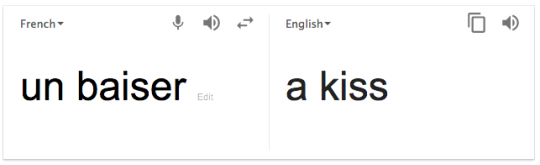
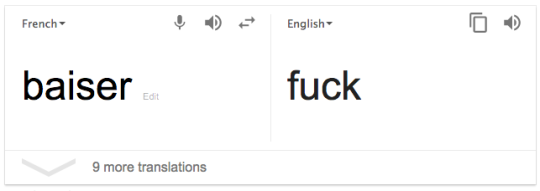
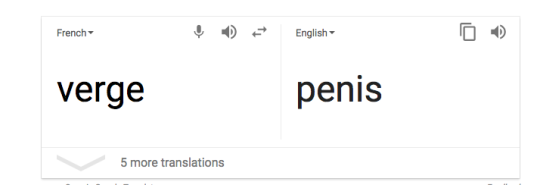
Here’s an interesting thing about French! Everything needs to have an article in front of it. That’s why it’s “la chat” as opposed to just “chat”. So, for instance, you could say la fille for the girl, or jeune fille for young girl, but you can’t just say fille, because that means you are calling her a sex worker in a derogatory way.
The moral of the story is, if you want to make something rude in French, just take out the article in front of it. Yes, this works for nearly. every. word.
Every year. Every year there’s that kid who forgets that you can’t translate “I am excited” to “Je suis excitée”. And every year Monsieur Jordan has to slam the brakes before that kid can finish his sentence and then tactfully ask him not to announce to the class that he is horny.
“is the french language always on the verge” oh buddy, oh pal, i am so happy to break this news to you:
To those fanfic writers that are not english native speakers: sometimes, when I read your work, I notice that english isn’t your first language, because there are strange phrases. I know immediately that to you, they are perfectly normal, since it’s the way your language describes things. And I love that, because here you go, creating your art, in a language you spent so much time learning, just so that other people can enjoy your stories! It is so amazing and I will never criticise you for that, but instead I will be thankful that you put in all the effort.
I love you all, you are amazing. Keep creating, please!
Writing is hard. Writing in a language that is not your native tongue is even harder. I love and respect the hell out of you all!
I read a book a while back, which I have completely forgotten the name of, but the author mentioned teaching poetry workshops to children of different age groups and said that the a lot of the younger kids came out with some really sublime stuff because they hadn’t internalised as many cliches and boring stock phrases in the English language yet, while the older kids tended to write very formulaic stuff in comparison. I think that writers working in a language that’s not their native tongue bring a similar quality to their work. You’ll see phrases that a native speaker could never come up with that are so fresh and beautiful.
We native English speakers tend to do a lot of washing in each others’ water, so to speak, when it comes to writing. We’re all drawing from the same stock pool of set phrases, idioms, metaphors, and classic literary references.
You second-language folks, you bring the fresh and the new into that pool, and I absolutely am grateful for that.
unfortunately there isn’t really a way to say that in classical latin, which is what i’m familiar with. you could probably do it as a 3rd declension common gender noun (i.e. one that covers multiple genders) but i’m not really great at coming up with latin words. @interretialia is much better with neo-latin stuff so i’ll point you his way!
i found something that might work! consors, literally sharing the same fortune. it can refer to a brother or sister, and it’s a 3rd declension (substantive) adjective, so it doesn’t have separate masculine/feminine forms. it can also mean comrade. the downside: this is only for classical latin; it starts to mean “wife” in medieval latin (which is how we eventually got the word “consort”).
In German, there are two translations for ‘the same’: der/die/das gleiche and der/die/dasselbe.
They don’t describe the same concept of same-ness (Is that even a word? Well now it is). Dasselbe means ‘that exact same thing’ while das gleiche means something like ‘an exact copy of that thing’.
Look at my amazing editing skills these graphics to illustrate the difference:
Something even Germans get wrong all the bloody time.


 theproblemwithstardust